Archives

Merry Material World! Capitalist Distortions of Sacred Rituals, Sacrifice and Spiritual Celebrations

Is you holiday about getting the cheapest price, securing the rarest limited edition collectible items and competing with others to win the title of champion gift giver? The survival of the fittest mentality and pervasive sense of aggression, competition, ownership, possession, desperation, and impulsive consumption suggests that we need to re-evaluate our American Ideology, and ask ourselves whether our over-zealous, flashy, and often financially irresponsible “holiday spirit” truly reflects charity, or something more complex and far darker. The charitable spirit of the season reflects a time when humans traditionally faced very real scarcity of vital resources – food, shelter, warmth, water, fire, animals to hunt or slaughter, plants to forage or harvest – and they needed to collectively create an insurance network that would prevent dissent into chaos as more and more good families ran out of key resources, and began to revert to wild, fight or flight responses in desperation. Stealing, aggression, and violence emerged only when their needs were ignored, and those who still had stores kept the excess for themselves. This season is about sharing what we have to prevent one another from sliding into homelessness, poverty, starvation, deprivation, and scarcity. Gifts are used to recalibrate social and psychological balance between two individuals who can enhance one another’s wealth, prevent suffering or exchange one needed resource for another. Charity is about giving to those who need; but it is also about giving what is sustainable – not the excessive, unaffordable, financially reckless gestures that we feel pressured into performing because charity has been made into a competitive sport to increase profits. Think about your options, and choose gifts that enhance the stability, beauty, connectedness, and emotional bond in your relationships. Do not turn you into a frenzied, desperate consumer; Charity is not about suffering – true charitable acts feel good, and trade personal excess for affection, love, and a reciprocal promise to share with one another

The American spirit of competition pervades every facet of our lives, and in recent years an unhealthy, obsessive, unsustainable, and culturally destructive mentality has infiltrated even the most sacred aspects of human life. Ritualistic seasonal celebrations – like Christmas, Hanukkah, Thanksgiving, and Kwanza – emerged as a defense against the constant decent into primitive aggression and moral depravity created by the traumatic winter/drought season. The natural scarcity of food, water, heat, light, and many other life forms during these cyclical cleansing periods (which made room for new growth by shedding worn out, diseased, non-functional structures that would otherwise become destructive in their overgrown state) impeded human culture for thousands of years because humans could not understand the benevolent, merciful, healing qualities of annual death and rebirth cycles. Not perceiving that this cyclical redistribution of energy remains critical to ecological balance (much like a last resort defense against overpopulation) humans overlooked the very conceptual framework that could save them from their seasonal suffering. The winter/drought season (much like sleep and rest function in neural/physical healing processes) destroys mostly the broken, corrupt, excessive, unsustainable, suffocating, stagnant and overgrown/overpopulated manifestations of life energy that have become redundant, mutated, destructive or simply detrimental to harmony, balance, cooperative co-existence and function. Like an overgrown tree that blocks all light, and kills every seedling below it, humans can become resource sucking monsters, especially when they are overpopulated; however, our unique gift is that we can choose to share and redistribute energy before we become unbearably oppressive and detrimental to the system. The tree cannot prune its branches to let the light in; but we can give others what they need, and we do not. Thus, until humans could emulate this seasonal process by controlling their own excessive hoarding, and sharing surplus wealth, the annual dark age persisted each year. As various cultures replaced some exclusive/individual ownership codes with a higher ethical responsibility compelling generosity/sharing/charity with those who have contributed, but due to circumstance or chance did not reap the same rewards – they finally overcame the yearly dark age that stifled cultural advancement. Through communal stores of surplus wealth, food, and critical resources that could be shared over the coming months, everyone was ensured survival, security, and cultural stability, harmony, and reciprocity. The joy, cheer and warmth of the holidays reflect this interconnectedness and our interdependent nature as human beings. In the end, exclusive ownership of one’s harvest only seemed sensible to those whose crops were not affected by disease, natural disaster, or drought, but it remains painfully obvious that no one could predict, avoid, or circumvent the random hardships and deprivation/scarcity to come.

A dark age often polarizes the gap between rich and poor – but humans posses the “divine gifts” of various spiritual insights brought upon by the cyclical random suffering of seasonal scarcity. Suffering evokes transcendence, inner peace, compassion and eventually, human cultural/physical/spiritual evolution. Like sunrise follows darkness, dark ages can only precede enlightened ones. When humans have evoked or re-discovered this higher purpose (a greater good, a holistic approach to poverty and starvation, interconnectedness, oneness – sometimes personified as a deity or god/goddess), new technological/cultural advancements can be implemented. Our celebrations, though formatted as rituals and practices – are a reminder of our inner darkness and search for light. The holidays evoke symbiotic interconnectedness, and remind us to redistribute wealth/skills/knowledge/resources and share shelter, food, and material goods to fend off the fight or flight desperation and oppression that engender and sustain all evil on this earth.


The Art of Personal Mythology – Body Decoration & Fashion Without Planned Obsolescence

To live is to enact a personal mythology – an interwoven series of visually-encoded stories – rich with the same stylistic elements that define every other art form. Our identity is not merely a disposable garment, shed simply because it requires mending, appears old, or has changed beyond recognition; nor are the outer symbols we assume to communicate this inner reality meaningless fashion trends to be forgotten. Instead, Lace Exoskeleton encourages individuals to utilize sustainable, Eco-friendly, and modular concepts to build their personalized “exoskeleton” of collaged, appropriated and collaboratively-constructed fashion pieces that form a continuous artistic gesture of creating, sharing, borrowing, altering, and re-creating visual identity. Life – including the ways in which we decorate our bodies – represents a collection of fleeting moments punctuated by the myths, stories and patterns of self-discovery that become the first thread of meaning in a life long transformation.

Lace Exoskeleton challenges customers to take their fashion statement further by collaborating in an interactive artistic experience, which encourages these individuals to utilize items purchased from Lace Exoskeleton to create truly personalized, fulfilling, visually engaging, and conceptually stunning wearable art that grows and adapts to the person – rather than the person adapting to fashion itself. Through empowering customers to assume artistic authorship over the aesthetic impressions and persona they actively create – and curate – via fashion, we hope to capture the essence of each person’s innermost visions, dreams, and existential reflections. To live is to enact a personal mythology – to create an interwoven series of visually-encoded stories – rich with the same stylistic elements , satire, symbolism, irony and beauty that define every other art form.

We believe:
Every
BODY
Is a
MASTERPIECE

And ask,
What does YOUR lace exoskeleton look like?

The Better to Eat You With My Deer…

The Better to Eat You With My Deer...

In a universe driven largely by two impulses – attraction and repulsion – one cannot overlook the intimate connection between sexual attraction and our most well-hidden cravings for everything sweet, salty, and dripping with creamy hot fudge, strawberries and sprinkles. Yes, we lust for “something sweet” on multiple levels, and these two very different forms of “hunger” often evoke an impulsive, voracious – and, at times even uncontrollable – desire to consume, ravage, posess and “eat up” every little morsel of those delicious things which we most desire. Food and sex, however, share more than a mere figurative similarity with one another – as metaphor, simile and other figurative comparisons tend to mirror inner truths hidden beneath the flowery, poetic frivolity of these playful conceptual juxtapositions. One obvious facet of this inner truth involves the uncanny similarities in how we advertise, decorate, embellish and present our bodies [and our dessert plates!] to attract others – not only to ourselves, but also to our most sinful culinary delights. Just as the most coveted desserts visually convey a sense of indulgent, rich, and multi-layered sensual temptation, so too do we attempt to convey depth, richness, and intellectual decadence to our admirers. A more detailed discussion to follow, with lots of pictures of cupcakes – so do not miss out!

LUSH Rituals ~ Evoking the Sacred Through Beautification & The Seduction of Scent

LUSH Rituals ~ Evoking the Sacred Through Beautification & The Seduction of Scent

We begin our discussion of the Lace Exoskeleton ~ the shifting, shimmering, mercurial identity that humans construct, destroy, create, perform, edit, layer and re-envision continuously, through various conscious and unconscious modes of representation. Each person’s “lace exoskeleton” evokes a delicately interwoven set of sensual
experiences (i.e., perceptions: sight, sound, taste, touch and scent that contain covert or hidden meaning). Below the surface of perception, messages, signifiers, and stimuli arouse sensual interpretation, which metamorphoses into a subtle cultural text wherein narratives of identity, self, and persona lie hidden, awaiting a competent reader who understands their implicit meaning. Through the art of suggestion, innuendo, and implication, these encoded impressions often lie just beyond the fringes of verbal representation. As a more intimate, raw, ambiguous communication of identity, the “lace exoskeleton” remains encrypted within a realm of abstraction, behind a locked door which remains impervious to most attempts to define, label, capture, and preserve its inner meaning. In other words, much like awakening from a dream, the lace exoskeleton resists linguistic representation, often changing, fading, or evading our attempts to classify, understand, trace or rekindle its original glow, despite the embers almost always remaining lit.

Let us begin with the sensual experience of smell, and through it perhaps we might understand a small shard of this puzzle which only shatters upon closer inspection.

To understand this, I will provide the example most close to my heart, involving the rituals of bathing in expensive bath products and layering scent after scent onto my body before a burlesque performance.

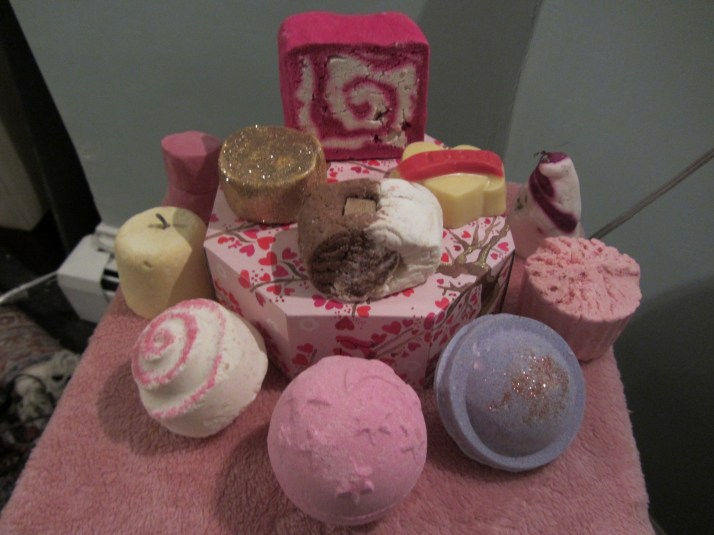
LUSH creates handmade bath products like those pictured above. As part of my performance ritual, these strangely addictive little “bath ballistics” are a multi-layered sensual experience in and of themselves ~ bursting, fizzing, crackling, and bubbling fervently, releasing streams of color, confetti, sparkles, and glamorous surprises like rose petals, paper hearts, or gold lustre dust.

Why do I include my LUSH collection as part of my performance art portfolio? Essentially it is about the concept of constructed identity, which begins, even before clothing, with layers of scent. The spiritual nature of bathing, beautification, and applying makeup, perfume and skin products has a meditative quality unlike anything else.

Historically, women would engage in these activities communally, much like they do before a wedding or special event (as would men in some cultures). Unfortunately, the sacred qualities of these moments have been overshadowed by misguided confusion between vanity and the rituals of feminine body modification. For me, LUSH is particularly loaded with transcendent value because it fills the room with sensual (that is, related to the senses, rather than related to sensuality, which is another thing all together – the sense of smell, olfactory stimulus) context, much like an incense burner fills a church or temple with a sacred aroma, intended to induce various states of relaxation and religious or spiritual receptivity. Essential oils have a lot of value as ways of inducing relaxation, calm, and infusing the pre-performance moments with ritualistic meaning.

This is essentially in homage to the fact that ritual has many forms, and spirituality likewise assumes many disguises, both recognized and hidden. Although identity changes visually when a person assumes or removes various disguises, the traces of other “applied” identities remain – scents, like perfumes, soap or shampoo, the “stain” or powdery film of lipstick, eyeshadow, mascara and lipstick – as well as more permanent versions of bodily decoration that “cover” what is underneath naturally, although we do not consider them valid coverings. For example, even when makeup, perfume and clothing are removed, piercings, tattoos, hair-dyes, nail-polish, prosthetics, implants, scars, scratches, and many other forgotten “imprints,” remain as evidence of identity, illustrating how much humanity relies upon these imprints to construct meaning, and suggesting that they function beyond the mere realm of frivolous vanity or narcissistic obsession.

And even without the obvious imprints, early humans – without ample covering naturally – relied upon these covering to ensure survival. Although it seems very far removed, identity construction – the human exoskeleton is very much the same – a layered, multi-faceted, shifting “collage” of appropriated material, without a truly “natural state” existing underneath. The natural state of all life involves imprints, and whether we don mud, fig leaves, coach purses, mink, dreadlocks, torn denim, or our underlying skin, all of our states of veiling, unveiling – and everything in between – remain uniquely inherent to the human experience of self.

Thus, the point is that there is no “natural state” for a human. All states are imprints – of culture, of climate, of sexual attraction, motherhood, protection, beauty, symbolic communication, group membership, mood and rich meaning. To refer to any state as” natural” (or more “real” or “true”) denies the fact that humans by nature may be predisposed to develop an identity, but do not do so when deprived of a culture, or role-models, to imitate, mirror, emulate, rebel from, and in general to react to via identity formation. “Natural” means that it fits pleasantly between personal desire and social rules, selfish whims and selfless compromise, such that external environment and internal subjectivity align with as little friction as possible.

In short, it is not natural for a human – with critical thinking and problem solving skills – to walk around naked in sub-zero weather (unless it is for some strange cultural ritual – The Polar Bears in Wisconsin for example), or to refuse to bathe or brush his/her hair when it is obvious that hygiene corresponds with health (unless this choice is due to cultural rebellion, or aesthetic preference for the “messy” style, and intended to communicate a sense of cultural alienation/challenge or a different interpretation of beauty ideals – I like my fiance Roger as a dirty hippy, but certainly would not dress this way myself!), or to assume that any racial features (which were developed as lovely adaptations for specific contexts, just like different clothing styles reflect climate – though skin color is a much slower and more genetically permanent version of the “fashions” we use to protect ourselves, communicate, convey group identity, attract others, repel or scare enemies, and celebrate identity and human gifts from a collective, divine, or spiritual shared existence) are more natural, superior or advanced than others.

Change and innovation are only successful if there is a need for change – the human phenotype changed until we learned to change it ourselves via clothing and other inventions that negate the need for many of these slow genetic shifts. Though of course, these genetic changes still occur in a gradual manner. Just because one phenotype is first, it does not make it superior, nor does a later version with updates denote progress; the phenotype is only as good as the context, environment, culture and reality that surround it allow – and at any moment, any one of the many variations of human forms might become more resilient to a disease or more susceptible to another, more prone to a particular illness or more resistant to another. But together we can cooperatively resist disease and ensure health if only we allow ourselves to see past the many veils of deceptive difference that constitute the human exoskeleton ~ the interwoven, fluid figurative “skin” we call THE LACE EXOSKELETON.

Burlesque Performance ~ Jaded Fetish Party

Burlesque Performance ~ Jaded Fetish Party

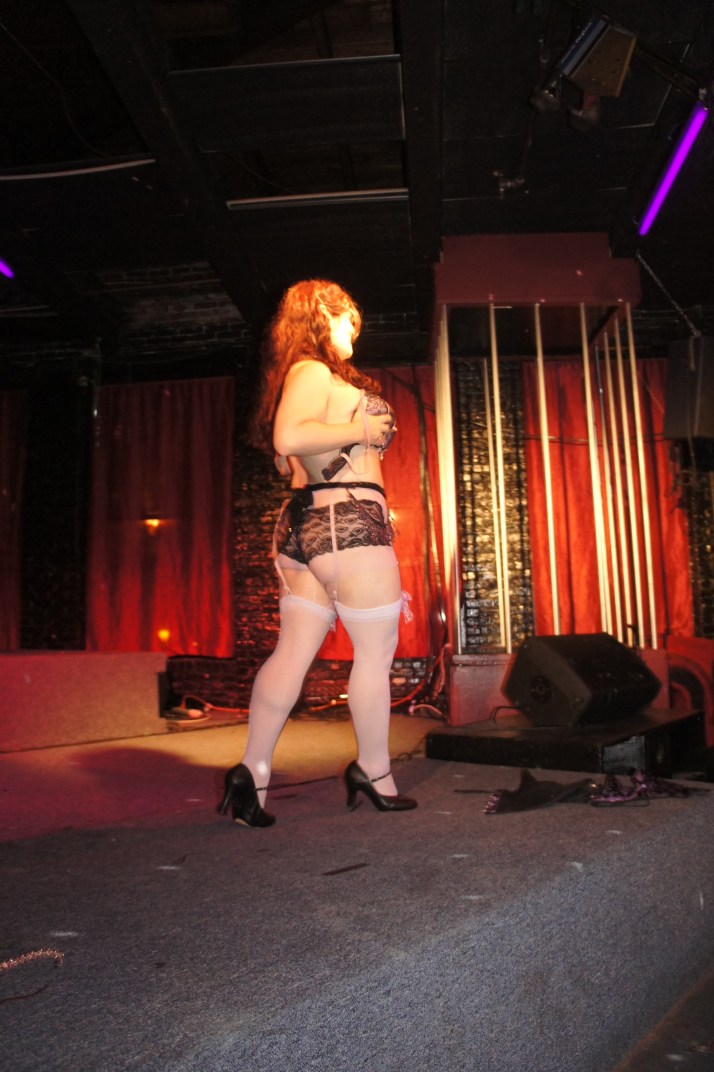
Clarissa Cupcake’s recent performance @ Jaded evokes the ecstatic transcendence of “head space”, erotic climax, and out of body experience – perhaps the frantic movement and elated glow of burlesque evoke sacred sexuality?